A fractional CMO’s case for why channel-based silos aren’t just inefficient — they’re actively costing you competitive ground, right now.
Let me say the quiet part out loud: most marketing organizations are currently paying six-figure salaries for skills a $20-a-month subscription now handles faster, at scale, without sick days. If your team structure still looks the way it did in 2019, you’re not running a marketing department. You’re running an expensive, slow-moving production line — and AI just built a faster one next door.
I’ve spent the better part of the last two decades being brought in to fix marketing departments that have stopped working. The org charts are almost always identical. There’s a Content Manager, a Social Media Specialist, an Email Marketing Lead, maybe a Paid Media person. Each owns a channel. Each guards their lane. And the whole structure was designed, consciously or not, around production volume as its single priority.
That structure wasn’t wrong. Before generative AI centralized tactical execution, you needed multiple people to maintain multiple instances of the same foundational skills (basic copywriting, basic asset creation, basic A/B testing). It was redundant, but it worked. The factory model was the only model.
Then the factory became obsolete.
The 70/30 problem — and why buying tools didn’t solve it
Here’s the insight most AI strategy conversations skip past – a high-performing specialist historically spent roughly 70% of their day on low-value, tactical production – drafting, scheduling, resizing, segmenting — and 30% on the thinking that actually moved the business. AI fills that 70% gap. It executes faster and more accurately than any human in that mode.
The rational response is to flip the ratio. Free your people from the production layer so they spend 70% of their time on strategy and 30% on governance. But that flip doesn’t happen automatically. You have to rebuild the organization to demand it.
Most companies bought the tools and kept the old structure. That’s not a technology investment. That’s an expensive way to produce mediocre content faster.
A 2025 Gartner survey of over 400 marketing leaders confirmed it – only 5% of marketing leaders not restructuring around AI report significant gains on business outcomes. The tool isn’t the problem. The structure is.I see this constantly. A company invests in a full AI martech stack — generation, automation, personalization — and then leaves the same channel-based team in place to ‘manage’ it. The result is a team of specialists who are now, functionally, prompt-based operators. You’re paying for strategic talent to do clerical work with better tools. The waste is invisible on the org chart but brutal on the P&L.
The roles that are actually obsolete (and what replaces them)
Let’s name what everyone is dancing around. Three roles as they are traditionally defined are in structural decline – the high-volume content generator whose output is measured in posts per week, the stand-alone channel specialist whose value is tied to a single platform, and the production designer whose primary job is asset resizing and template iteration. AI does all three faster, cheaper, and without needing a creative brief.
What replaces them isn’t headcount reduction. It’s role evolution. The Content Generator becomes a Brand Editor, sourcing original research, owning the voice, governing AI output for accuracy and tone. The Channel Specialist becomes a Customer Journey Architect, not sending emails, but ensuring the email connects to the in-app action and anticipates the retargeting. The Production Designer becomes a Brand Identity Guardian who sets the aesthetic standard that AI-generated volume has to meet.
These are harder jobs. They require more judgment, more range, and more ownership of outcomes rather than outputs. That’s exactly the point.
The two hires most CMOs haven’t made yet
Rebuilding around outcomes rather than channels requires two roles that most marketing organizations don’t have — and most job descriptions haven’t been written for yet.
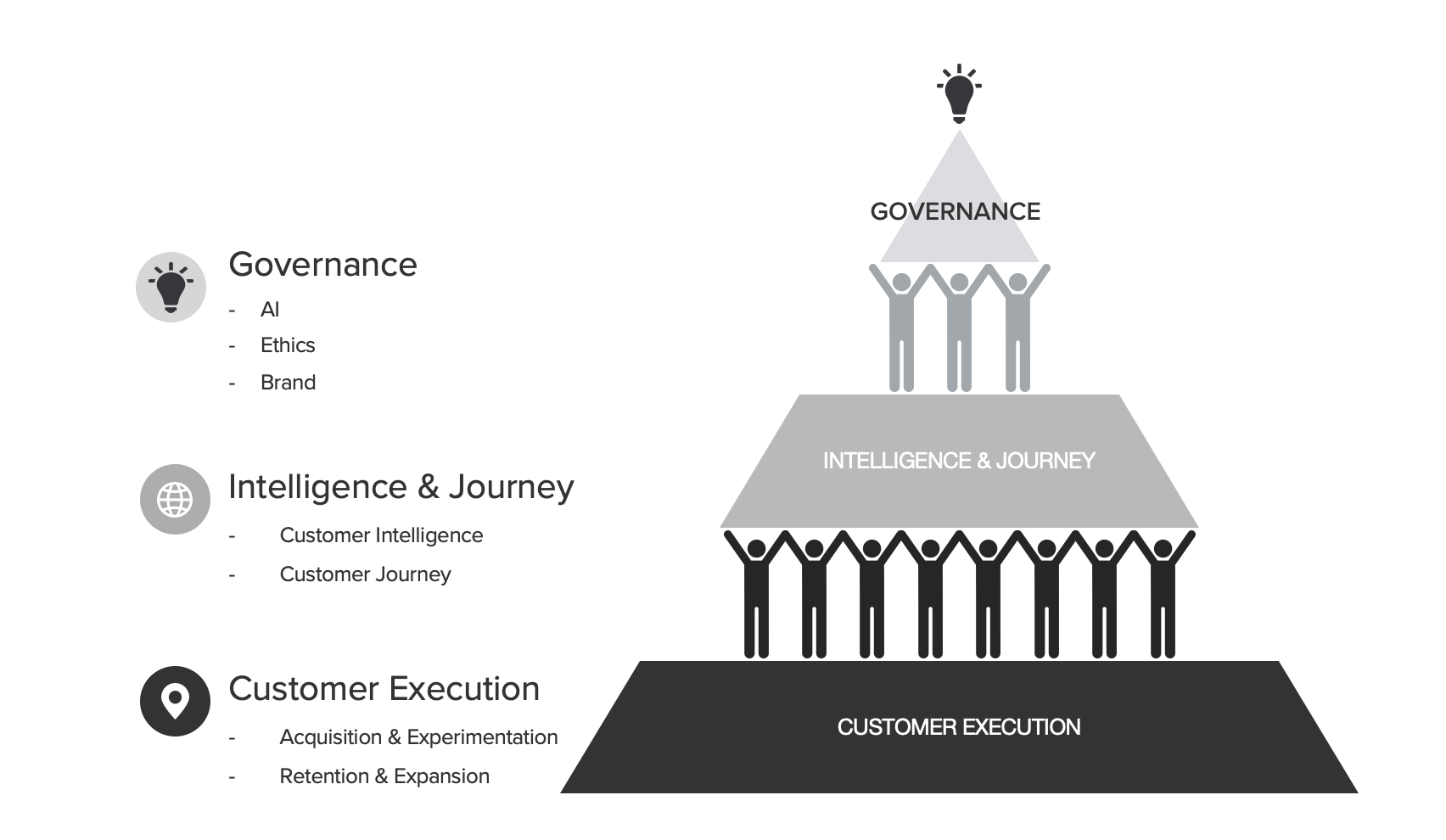
The first is a Head of AI Governance. This is your most mission-critical new hire, and it should report directly to the CMO. Their job is not to evaluate AI tools. Their job is to protect the brand from AI’s speed. They build the prompt library, establish compliance audits for AI-generated output, manage data security, and constantly check models for bias or factual drift. Without this role, AI doesn’t make your marketing better. It makes your mistakes faster and your brand risk higher.
The first is a Head of AI Governance. This is your most mission-critical new hire, and it should report directly to the CMO. Their job is not to evaluate AI tools. Their job is to protect the brand from AI’s speed. They build the prompt library, establish compliance audits for AI-generated output, manage data security, and constantly check models for bias or factual drift. Without this role, AI doesn’t make your marketing better. It makes your mistakes faster and your brand risk higher.
The second is a Head of Customer Intelligence. As third-party data crumbles and attribution models break down, this leader becomes the person who ensures marketing isn’t just busy — it’s right. They translate business objectives into measurable AI-driven experiments. They feed proprietary insights back to the teams doing the work. They are the difference between a marketing org that moves fast and one that moves fast in the right direction.
The generalist is back (thanks, AI!)
The irony of the AI era is that it’s bringing generalists back. For two decades, marketing rewarded specialization — own a channel, master its tools, guard your lane. AI just made that logic obsolete. When a $20 subscription handles the production layer across every channel, the specialist’s core value proposition evaporates.
What replaces them is a marketer who owns an outcome, not a channel. Someone who can orchestrate content, email, paid, and social as a unified system — using AI as the production engine and their own judgment as the governor. They don’t ask “what does my channel need this week?” They ask “what does this customer need next, and what’s the fastest path to get there?”
Structurally, this means reorganizing teams around business outcomes rather than platforms: one team owns acquisition and top-of-funnel experimentation, another owns retention and lifetime value. The channel becomes a tactical detail. The outcome becomes the job title.
The Action Plan
Audit first. Identify what percentage of each specialist’s day is spent on work AI now handles. That gap is your budget leak.
Don’t cut. Reinvest. The efficiency gain frees 30–40% of your tactical budget. Every dollar of it should go into the strategic layer (governance, intelligence, and the generalist marketers who own outcomes), not channels.
Retrain before you rehire. A high-potential specialist who knows your business is worth more than a new hire who doesn’t. Invest in the transition. The ones who embrace it will become your most valuable people.
The close that matters
Here’s the move most executives won’t make. When AI creates efficiency, the instinct is to capture it as cost savings. Cut headcount, reduce the budget, report the margin improvement. That move makes the next quarter look better and the next three years look worse.
The companies that cut will be faster and dumber. The companies that reinvest will be faster and smarter. That gap compounds. And right now, while your competitors are still in ethics committee meetings debating the responsible use of ChatGPT, you have a window to build the structure they haven’t imagined yet.
Your org chart is not a neutral document. It is a statement of what you believe drives marketing value. If it still reflects a world where value comes from channel ownership and production volume, it is telling your team — and your business — the wrong story.
The collapse of the old structure is not a threat. It is an invitation to build something your 2019 self couldn’t have conceived. The question is whether you move before the window closes.